Amino-PEG and Carboxyl-PEG are two widely used functionalized polyethylene glycol (PEG) derivatives in bioconjugation, linker synthesis, and biomedical research. The main difference is the reactive group: Amino-PEG contains an amino group (-NH2), while Carboxyl-PEG contains a carboxyl group (-COOH). Their functional groups determine how they participate in chemical coupling reactions and which molecular partners they can connect.
Amino-PEG is commonly used as an amine-bearing component in reactions with activated carboxyl groups. Carboxyl-PEG is often selected when a carboxyl group needs to be coupled with an amine after suitable activation. Both materials can support amide bond formation, but they play different roles in the reaction.
For researchers developing protein conjugates, peptide modifications, polymer systems, or drug-linker intermediates, choosing between these two PEG derivatives starts with identifying the available reactive groups on the target molecule. SINOPEG offers amine-functionalized PEG products for projects requiring amino groups and related molecular structures.
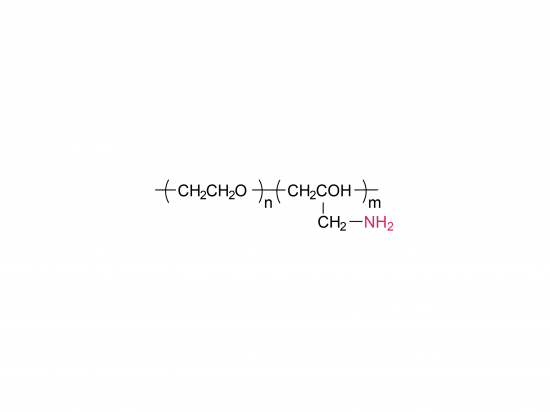
Illustration of an amino-functionalized PEG structure.
What Is Amino-PEG?
Amino-PEG is polyethylene glycol modified with an amino group, typically a primary amine (-NH2), at one or more defined positions. The PEG chain provides a hydrophilic spacer, while the amino group serves as a reactive handle for further chemical modification.
In a common bioconjugation strategy, Amino-PEG reacts with a suitable activated carboxyl group to form an amide bond. For example, a carboxyl-containing molecule may be activated using an appropriate coupling system before the amino group on PEG is introduced.
Amino-PEG can be useful in several research applications:
- PEG linker synthesis: Provides an amino handle for attaching PEG to a molecule with a compatible activated group.
- Peptide and protein modification: Supports conjugation strategies when the other component contains an appropriate reactive partner.
- Polymer functionalization: Introduces an amino group for subsequent chemical modification or material construction.
- Biomedical material development: Can be incorporated into selected delivery systems, surface modifications, and functional polymer structures.
The exact application depends on the complete molecular structure. A free amino group is not interchangeable with an NHS ester, maleimide, or other activated functional group. Researchers should confirm the actual end groups and reaction compatibility before selecting a reagent.
What Is Carboxyl-PEG?
Carboxyl-PEG is polyethylene glycol functionalized with a carboxyl group (-COOH). This group can be used as a reaction handle for amide bond formation, esterification under suitable conditions, or other chemical transformations depending on the target structure and reaction design.
For common amide coupling reactions, a carboxyl group generally requires activation before it reacts efficiently with an amine. Coupling systems such as EDC, sometimes used with NHS, can facilitate the formation of an amide bond under appropriate conditions.
Carboxyl-PEG is useful when a synthesis route requires a carboxyl-bearing spacer or when the target molecule contains a suitable amino group. It may also be selected for preparing bifunctional linkers in which the carboxyl group is one of two distinct reactive handles.
Researchers can review SINOPEG's Carboxyl-PEG product category to explore carboxyl-functionalized PEG derivatives for different molecular architectures and research requirements.
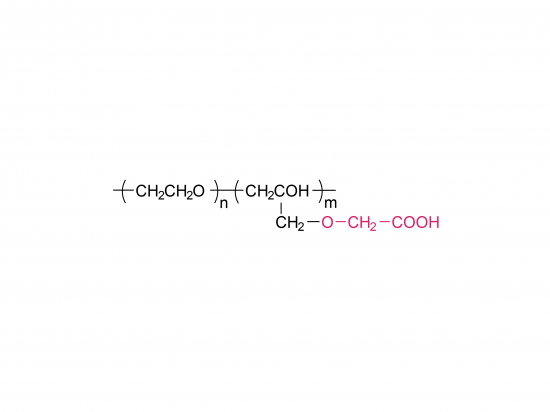
Illustration of a carboxyl-functionalized PEG structure.
What Are the Key Differences Between Amino-PEG and Carboxyl-PEG?
The most important difference is the functional group and its role in the planned reaction. Both PEG derivatives can be used in linker synthesis and bioconjugation, but they require compatible reaction partners and may need different preparation steps.
| Comparison factor | Amino-PEG | Carboxyl-PEG |
|---|---|---|
| Functional group | Amino (-NH2) | Carboxyl (-COOH) |
| Typical coupling partner | Activated carboxyl group | Amine, following suitable activation |
| Common bond formation | Amide bond formation | Amide bond formation |
| Typical reaction preparation | The carboxyl-bearing partner may need activation | The carboxyl group usually needs activation for amide coupling |
| Common design role | Provides an amino reaction handle | Provides a carboxyl reaction handle |
| Selection priority | Compatibility with the other molecule's activated group | Compatibility with the amino partner and activation chemistry |
Neither functional group is universally better. The appropriate choice depends on which reactive groups are available, which component is easier to activate, the desired reaction sequence, and which functional groups must remain available in the final conjugate.
How Do Amino-PEG and Carboxyl-PEG Participate in Amide Coupling?
Amide coupling is a common approach for connecting PEG derivatives to molecules containing suitable amino or carboxyl groups. In a typical strategy, one component supplies the amine and the other supplies an activated carboxyl group.
For example, Carboxyl-PEG can be coupled with a molecule containing a suitable primary amine after the carboxyl group is activated. Conversely, Amino-PEG can react with a different molecule whose carboxyl group has already been activated.
The general reaction can be represented as follows:
Activated carboxyl group + primary amine → amide bond
The precise reaction conditions depend on the coupling reagent, solvent or buffer, pH, temperature, and the stability of the target molecule. EDC/NHS chemistry is one possible approach, but it is not suitable for every molecular system without further evaluation.
It is also important to distinguish a free carboxyl group from an activated ester. An NHS ester is an activated carboxyl derivative that can react with suitable primary amines. It should not be treated as chemically equivalent to unactivated Carboxyl-PEG.
For more detailed guidance on selecting reactive groups and matching them to the target molecule, see SINOPEG's article on PEG functional group selection for bioconjugation.
When Should Researchers Choose Amino-PEG?
Amino-PEG is a practical candidate when the intended synthesis requires an amino-bearing PEG spacer. It is particularly relevant when the other component contains a compatible activated carboxyl group or when the amino group will be used in a subsequent derivatization step.
Before selecting Amino-PEG, researchers should consider:
- Reaction compatibility: Confirm that the intended coupling partner can react with the amino group under suitable conditions.
- Functional group availability: Check whether the amino group needs protection during earlier synthesis steps.
- PEG chain length: Select a spacer that suits the intended molecular distance and application.
- Linker architecture: Determine whether a monofunctional or bifunctional PEG structure is required.
- Final product requirements: Consider purity, molecular identity, conjugation efficiency, and downstream characterization.
When the synthesis requires two different terminal groups, a heterobifunctional PEG may be more appropriate than a simple amino-terminated PEG. The second group must remain compatible with the planned reaction sequence and final application.
When Should Researchers Choose Carboxyl-PEG?
Carboxyl-PEG is suitable when a carboxyl group is needed for subsequent coupling, derivatization, or linker construction. It can be particularly useful when the other molecule contains an accessible amino group and the synthesis route supports carboxyl activation.
Common design considerations include:
- Activation strategy: Choose a suitable coupling method based on the target molecule and reaction environment.
- Competing functional groups: Assess whether other amino or carboxyl groups could lead to unwanted products.
- Reaction selectivity: Consider whether the intended coupling needs to occur at a particular molecular site.
- Intermediate stability: Evaluate whether activated intermediates remain stable long enough for coupling and purification.
- Product structure: Confirm whether one carboxyl group or multiple reactive sites are required.
For example, a PEG derivative with carboxyl groups at both ends may support different linker construction strategies from a PEG molecule with only one carboxyl group and one methoxy or hydroxyl terminus. Researchers should therefore evaluate the complete structure rather than selecting a reagent based only on the name Carboxyl-PEG.
How Do PEG Molecular Weight and Linker Structure Affect Selection?
Functional group identity is only one part of PEG reagent selection. Molecular weight, chain length, the number of functional groups, and the arrangement of those groups can all influence the suitability of a material for a particular project.
A longer PEG chain may provide greater separation between molecular components and can change the hydrodynamic properties of a conjugate. However, longer chains are not automatically better. The optimal spacer depends on the target molecule, desired geometry, solubility requirements, and biological or material performance.
Researchers should also distinguish between the following PEG architectures:
- Monofunctional PEG: Usually has one principal reactive group for a defined modification strategy.
- Bifunctional PEG: Contains two functional groups that may support coupling at both ends.
- Heterobifunctional PEG: Carries two different functional groups for sequential or complementary coupling reactions.
- Multi-arm PEG: Provides several functional arms for applications requiring multiple attachment points or network formation.
For projects requiring a defined PEG structure and two different reactive handles, researchers may consider SINOPEG's PEG derivative portfolio and compare the available architectures against their molecular design requirements.
What Should Researchers Check Before Ordering Amino-PEG or Carboxyl-PEG?
Before selecting a PEG reagent, researchers should confirm that the listed product structure matches the intended reaction. A functional group label alone does not establish molecular weight, terminal group arrangement, purity, or compatibility with a particular experimental protocol.
A practical checklist includes:
- Confirm the exact chemical structure and terminal functional groups.
- Verify the required molecular weight and PEG chain length.
- Check whether the product is monofunctional, bifunctional, or multi-arm.
- Determine whether the intended reaction requires an activation or protection step.
- Review available purity specifications and analytical documentation.
- Confirm storage conditions and handling requirements from the product documentation.
- Validate the reaction and final product using appropriate analytical methods.
The most suitable PEG derivative is the one that matches the intended molecular structure and reaction pathway, rather than the one with the most general-purpose description.
Frequently Asked Questions About Amino-PEG and Carboxyl-PEG
What is the main difference between Amino-PEG and Carboxyl-PEG?
Amino-PEG contains an amino group (-NH2), while Carboxyl-PEG contains a carboxyl group (-COOH). Their functional groups determine their roles in coupling reactions and the types of compatible molecular partners they can connect.
Can Amino-PEG and Carboxyl-PEG react with each other directly?
They can serve as complementary components in amide coupling, but the carboxyl group generally needs activation for efficient bond formation. The actual reaction depends on the structures, coupling reagents, and reaction conditions.
Which is better for bioconjugation, Amino-PEG or Carboxyl-PEG?
Neither is universally better. Amino-PEG is appropriate when an amino-bearing PEG is required, while Carboxyl-PEG is appropriate when a carboxyl-bearing PEG is needed. Selection should be based on the available reactive groups and the intended synthesis route.
Does Carboxyl-PEG need activation before amide coupling?
In common amide-forming reactions, a carboxyl group generally needs activation before reacting efficiently with a primary amine. EDC/NHS is one possible activation system, but the appropriate method depends on the target molecule and reaction environment.
What is the difference between Carboxyl-PEG and NHS-PEG?
Carboxyl-PEG contains a carboxyl group that commonly requires activation for amide coupling. NHS-PEG typically contains an activated NHS ester designed to react with suitable nucleophiles, especially primary amines. They have different reactivity and handling requirements.
Can Amino-PEG be used for protein modification?
Yes, in suitable reaction designs. Amino-PEG can be used when the protein or another coupling partner presents a compatible activated group. The best approach depends on protein structure, available reactive sites, and the need for conjugation selectivity.
How should researchers select the molecular weight of Amino-PEG or Carboxyl-PEG?
The molecular weight should be selected according to the desired spacer length, molecular architecture, solubility requirements, and application. The effect should be validated for the specific conjugate rather than inferred from molecular weight alone.
What information should be checked before purchasing a PEG derivative?
Confirm the chemical structure, functional groups, molecular weight, purity specifications, PEG architecture, storage requirements, and suitability for the planned reaction. Product-specific documentation should guide the final selection.
Scientific References
The following publications provide background on bioconjugation, protein modification, and chemical coupling strategies relevant to PEG derivative selection.
- Hermanson, G. T. (2013). Bioconjugate Techniques. Third Edition. Academic Press.
- Stephanopoulos, N., and Francis, M. B. (2011). Choosing an Effective Protein Bioconjugation Strategy. Nature Chemical Biology, 7, 876–884.
- Kolb, H. C., Finn, M. G., and Sharpless, K. B. (2001). Click Chemistry: Diverse Chemical Function from a Few Good Reactions. Angewandte Chemie International Edition, 40, 2004–2021.
- Hoyle, C. E., and Bowman, C. N. (2010). Thiol–Ene Click Chemistry. Angewandte Chemie International Edition, 49, 1540–1573.
These references provide general scientific background rather than a validated protocol for a specific PEG product. Actual reaction conditions and reagent selection should be confirmed against the relevant product specifications and experimentally validated for the intended application.
In summary, Amino-PEG and Carboxyl-PEG serve different but complementary roles in bioconjugation. Identifying the required reactive group, matching the coupling chemistry, and selecting the correct PEG architecture are the essential steps toward a suitable linker design.