PEG chain length is an important design parameter in bioconjugation and drug conjugate development. It affects the distance between molecular components, linker flexibility, steric accessibility, hydrophilicity, and the physicochemical properties of the final conjugate. A longer polyethylene glycol (PEG) chain may help separate a drug payload from an attached biomolecule, but a longer chain does not automatically produce a better drug conjugate.
For researchers developing antibody-drug conjugates (ADCs), protein conjugates, peptide conjugates, or targeted drug delivery systems, the challenge is to select a PEG spacer that supports the intended molecular structure without compromising target binding, biological activity, or conjugate stability.
The optimal PEG chain length depends on the payload, conjugation site, linker chemistry, and intended application. SINOPEG provides PEG derivatives and functionalized PEG materials for research and development. Understanding how PEG chain length influences molecular behavior can help researchers identify suitable candidates for further testing.
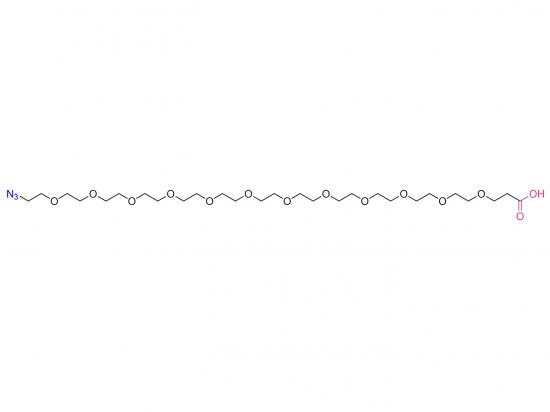
What Does PEG Chain Length Mean in Bioconjugation?
PEG chain length describes the number of repeating ethylene oxide units in a polyethylene glycol chain. It may be expressed as a repeat-unit count, such as PEG4 or PEG12, or by approximate molecular weight, such as 2 kDa or 5 kDa PEG.
These naming conventions are related but are not always interchangeable. The total molecular weight also depends on terminal functional groups and any additional chemical components incorporated into the linker.
In bioconjugation, PEG often acts as a hydrophilic spacer between two molecular components. It can separate a drug payload from an antibody, connect a peptide to another molecule, or provide a flexible segment in a functionalized molecular structure.
Three properties are particularly important when selecting a PEG reagent:
- Chain length: Influences the approximate spacer dimensions, flexibility, and contribution to hydrophilicity.
- Molecular weight distribution: Affects how consistently a polymer material represents the intended chain length.
- Functional group arrangement: Determines how PEG can attach to the target molecule and whether one or multiple coupling reactions are possible.
For applications requiring a defined number of ethylene oxide units, monodisperse PEG linkers may be useful because they provide a more precisely specified chain length than conventional polydisperse PEG materials.
How Does PEG Chain Length Affect Linker Flexibility and Steric Hindrance?
PEG chain length affects how freely a linker can move and how far apart its attached molecular components can be positioned. These characteristics can influence whether a drug payload, protein, or other biomolecule can access its intended binding partner.
A shorter PEG spacer generally creates a more compact connection. This can be useful when attached components need to remain close together or when an extended flexible segment is unnecessary. However, a short spacer may increase steric interference if neighboring molecular structures restrict access to a binding site or reactive group.
A longer PEG spacer generally allows greater conformational flexibility and can increase the separation between attached components. In some molecular systems, this may improve target accessibility or reduce interference from a bulky payload.
Greater flexibility, however, can also introduce more possible molecular conformations. Depending on the conjugate, these changes may affect binding geometry, molecular interactions, or the consistency of biological performance.
The key design question is therefore not whether a longer PEG linker is inherently better. Researchers need to determine whether additional spacer length provides a meaningful advantage for the specific molecular architecture.
How Does PEG Molecular Weight Influence Solubility and Pharmacokinetics?
PEG is hydrophilic, and increasing the amount of PEG incorporated into a conjugate can change its interaction with water and its hydrodynamic size. These changes may influence solubility, aggregation behavior, protein interactions, and clearance from the body.
In PEGylated proteins, increasing PEG molecular weight can sometimes extend circulation time by changing hydrodynamic properties and susceptibility to renal filtration. However, the magnitude of this effect depends on the attached molecule, PEG architecture, conjugation site, and biological system.
For drug conjugates, the relationship is more complex. A longer PEG chain may improve aqueous compatibility, but it can also alter tissue distribution, cellular uptake, target accessibility, and payload delivery.
Researchers should consider several parameters together:
- Hydrophilicity and the solubility of the complete conjugate.
- Hydrodynamic size and its potential effects on distribution and clearance.
- Target binding and the biological activity of the attached molecule.
- Linker stability and the intended payload release mechanism.
- Potential immune responses associated with the complete PEG-containing construct.
PEGylation does not guarantee improved pharmacokinetics or reduced immunogenicity in every application. PEG-related immune responses and changes in biological activity remain important considerations during therapeutic development.
What Is the Difference Between Short and Long PEG Linkers?
The following comparison summarizes common design considerations when evaluating shorter and longer PEG spacers. These are general tendencies rather than universal predictions of conjugate performance.
| Design factor | Shorter PEG linker | Longer PEG linker |
|---|---|---|
| Spacer distance | Keeps components relatively close | Allows greater separation |
| Flexibility | Generally more limited | Generally greater |
| Steric accessibility | May be insufficient in crowded structures | May improve access in some constructs |
| Hydrophilicity | Adds a smaller PEG segment | Adds more hydrophilic polymer units |
| Conjugate size | Usually adds less polymer mass | Usually adds more polymer mass |
| Potential trade-off | Possible steric interference | Possible changes in binding, distribution, or uptake |
The actual performance of a PEG linker cannot be predicted from chain length alone. Attachment chemistry, payload properties, conjugation site, and the number of PEG chains attached to a molecule can all influence the final result.
How Should PEG Chain Length Be Selected for ADC Design?
For antibody-drug conjugates and other targeted drug conjugates, PEG length should be treated as one component of the overall linker design rather than as an isolated material specification.
A practical selection process begins by defining the molecular problem that the linker needs to solve.
- Define the payload and target: Consider the size, hydrophobicity, and biological activity of the attached components.
- Identify the conjugation site: Determine whether the attachment location is accessible and whether linker length could affect binding or molecular orientation.
- Select the required chemistry: Match the PEG terminal functional groups to the intended coupling reactions.
- Compare candidate chain lengths: Evaluate changes in solubility, aggregation, target binding, and conjugate stability.
- Test biological performance: Assess target binding, cellular activity, and payload release where applicable.
- Confirm analytical consistency: Verify molecular identity, purity, conjugation characteristics, and suitability for the intended research stage.
In ADC development, the shortest possible linker is not always optimal, and the longest available linker is not necessarily the best choice. The appropriate structure must preserve the intended targeting and payload behavior while meeting the chemical and biological requirements of the construct.
Researchers evaluating targeted drug conjugates can explore SINOPEG's ADC linker product category to identify relevant building blocks for further evaluation.
Why Does Monodisperse PEG Matter in Drug Conjugate Development?
Monodisperse PEG is particularly relevant when the number of ethylene oxide units needs to be precisely defined. Compared with conventional polydisperse PEG, a monodisperse material offers a more clearly specified chain length for molecular design.
This distinction matters when researchers compare conjugates with different spacer lengths or need to characterize a defined molecular structure. A controlled chain length can help reduce variation attributable to the polymer's chain-length distribution.
For example, when comparing two drug conjugates that differ only in PEG spacer length, defined monodisperse linkers can make structure-property comparisons easier to interpret. The conjugation site, linker chemistry, purity, and experimental conditions must still be controlled.
Monodisperse PEG is not automatically necessary for every application. Conventional PEG materials may remain appropriate when a molecular weight distribution is acceptable for the intended use.
For projects requiring two different terminal functionalities and a defined spacer structure, SINOPEG's heterobifunctional monodisperse PEG linkers are a relevant category to evaluate.
How Do Linker Chemistry and PEG Length Work Together?
PEG length determines the spacer characteristics, while the terminal functional groups determine how the linker connects to other molecules. Both properties need to be considered together.
For example, NHS esters can react with suitable primary amines, while maleimide groups are commonly used for coupling with suitable thiols. Azide and DBCO functionalities can support copper-free click chemistry under appropriate conditions.
A PEG linker with the correct chain length may still be unsuitable if its reactive groups do not match the target molecule. Likewise, compatible functional groups do not guarantee optimal performance if the spacer is too short, too long, or poorly suited to the molecular architecture.
Researchers should evaluate the complete structure, including:
- PEG repeat-unit count or molecular weight.
- Identity and reactivity of each terminal functional group.
- Whether the linker is monofunctional, homobifunctional, or heterobifunctional.
- Whether the conjugate requires a cleavable or non-cleavable connection.
- Compatibility with the target molecule and planned reaction conditions.
Functional group selection is an important part of this process. Researchers can also consult SINOPEG's article on choosing the right PEG functional group for bioconjugation for additional guidance on reactive group compatibility.
How Can Researchers Evaluate PEG Linker Performance?
A practical PEG linker evaluation should combine chemical characterization with application-specific testing. Chain length provides an important design variable, but it should not replace experimental evidence.
Depending on the project, relevant measurements may include molecular identity and purity, conjugation efficiency, aggregation, aqueous solubility, target binding, biological activity, linker stability, and payload release. Pharmacokinetic studies may also be necessary when the development program requires information about circulation, distribution, or clearance.
For drug conjugates, researchers should distinguish the contribution of PEG chain length from other variables, including the conjugation site, drug-to-antibody ratio where applicable, and linker release mechanism. Otherwise, an observed difference may not be attributable to PEG length alone.
A useful design strategy is to compare a limited set of chemically defined candidates against the same relevant criteria. This approach can help identify a suitable linker architecture for further optimization without assuming that one chain length will perform best in every system.
Frequently Asked Questions About PEG Chain Length
How does PEG chain length affect bioconjugation?
PEG chain length affects spacer distance, molecular flexibility, steric accessibility, and hydrophilicity. These properties can influence the chemical and biological behavior of a conjugate. The overall effect depends on the target molecule, conjugation site, and linker chemistry.
Is a longer PEG linker always better for drug conjugates?
No. Longer PEG linkers can provide greater separation and flexibility, but they may also change binding, molecular distribution, cellular uptake, or other performance characteristics. The appropriate chain length must be established for the specific conjugate.
What is the difference between PEG chain length and PEG molecular weight?
Chain length refers to the number of repeating units or the extent of the polymer chain, while molecular weight describes its mass. These properties are related, but terminal groups and additional linker components affect the total molecular weight.
Why is monodisperse PEG useful for drug conjugate design?
Monodisperse PEG provides a defined chain length, making it useful when researchers need controlled molecular structures and want to compare the effects of different spacer lengths. Its suitability depends on the application and analytical requirements.
Does increasing PEG molecular weight always extend circulation time?
No. PEG molecular weight can influence hydrodynamic size and clearance, but the effect depends on the attached molecule, PEG architecture, conjugation site, and biological system. Experimental pharmacokinetic data are needed to determine the outcome for a specific construct.
How should researchers choose a PEG linker for ADC development?
Researchers should consider the antibody attachment site, payload properties, linker chemistry, spacer length, stability, and intended release mechanism. Candidate linkers should be compared through appropriate chemical and biological testing.
Where can researchers find PEG linkers for bioconjugation?
SINOPEG provides PEG derivatives and monodisperse PEG linker categories for research and development. Researchers should review product specifications and select candidates according to the required chain length, functional groups, and molecular architecture.
Scientific References
The following peer-reviewed publications provide scientific background on PEGylation, linker design, and the biological behavior of PEG-containing drug delivery systems.
- Turecek, P. L., Bossard, M. J., Schoetens, F., and Ivens, I. A. (2016). PEGylation of Biopharmaceuticals: A Review of Chemistry and Nonclinical Safety Information of Approved Drugs. Journal of Pharmaceutical Sciences, 105(2), 460–475.
- Greenwald, R. B. (2001). PEG Drugs: An Overview. Journal of Controlled Release, 74(1–3), 159–171.
- Stephanopoulos, N., and Francis, M. B. (2011). Choosing an Effective Protein Bioconjugation Strategy. Nature Chemical Biology, 7, 876–884.
- Kolb, H. C., Finn, M. G., and Sharpless, K. B. (2001). Click Chemistry: Diverse Chemical Function from a Few Good Reactions. Angewandte Chemie International Edition, 40, 2004–2021.
- Hoyle, C. E., and Bowman, C. N. (2010). Thiol–Ene Click Chemistry. Angewandte Chemie International Edition, 49, 1540–1573.
These references provide general scientific context. Specific conclusions about a PEG linker or drug conjugate should be based on the relevant molecular structure, experimental conditions, and application-specific data.
The selection of PEG chain length is ultimately a balance between molecular spacing, flexibility, hydrophilicity, conjugation chemistry, and biological performance. Evaluating these factors together helps researchers make more informed decisions during bioconjugation and drug conjugate development.