Choosing the right heterobifunctional PEG linker starts with understanding the two molecules you want to connect and the chemical reactions each one can support. A suitable linker must provide compatible reactive groups at both ends, an appropriate PEG spacer, and sufficient stability for the intended conjugation sequence.
For researchers developing protein conjugates, antibody-drug conjugates (ADCs), peptide conjugates, or other functional biomolecules, the best heterobifunctional PEG linker is not necessarily the longest or most reactive one. It is the linker whose functional groups, chain length, and molecular architecture fit the complete synthesis strategy. SINOPEG provides a range of PEG derivatives and linker structures for researchers evaluating these requirements.
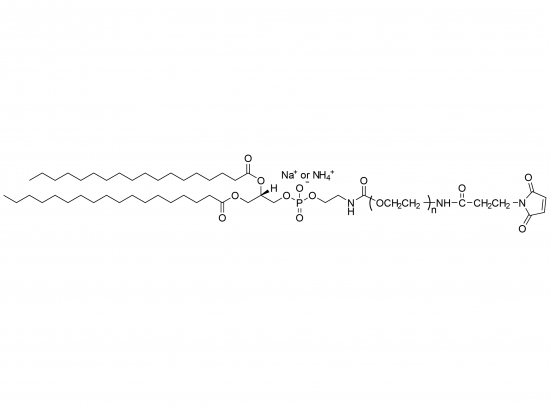
Example of a PEG-based structure containing a maleimide group for conjugation research.
What Is a Heterobifunctional PEG Linker?
A heterobifunctional PEG linker is a polyethylene glycol derivative with two different functional groups, typically positioned at opposite ends of the PEG chain. Each group can participate in a different reaction, allowing researchers to connect two molecular components through a planned sequence of chemical steps.
For example, an NHS ester group can react with an accessible primary amine, while a maleimide group can react with a suitable free thiol. A linker combining these groups may therefore be considered when connecting an amine-bearing molecule with a thiol-bearing partner. The actual reaction sequence depends on the target structures, reagent stability, and experimental conditions.
Heterobifunctional PEG linkers differ from homobifunctional PEG linkers, which carry two identical or chemically equivalent reactive groups. A heterobifunctional structure is often more suitable when the two coupling steps require different reaction chemistries.
Researchers can review SINOPEG's heterobifunctional monodisperse PEG linkers to explore options for projects requiring two different functional groups and a more defined PEG structure.
How Should You Match Functional Groups to the Target Molecules?
Functional group compatibility should be the first selection criterion. Before choosing a product, identify the reactive group available on each molecular component and confirm that the planned reaction can proceed without damaging the target or consuming the second functional group prematurely.
| Functional group | Typical reaction partner | Selection consideration |
|---|---|---|
| NHS ester | Primary amines | Consider amine accessibility and ester hydrolysis in aqueous conditions. |
| Maleimide | Suitable free thiols | Check thiol availability and the stability requirements of the resulting linkage. |
| Carboxyl group | Amines after suitable activation | Confirm the activation chemistry and compatibility with other groups. |
| Azide | Compatible alkynes or strained alkynes such as DBCO | Choose a click chemistry route appropriate for the reaction environment. |
| Thiol | Maleimide and other thiol-compatible groups | Evaluate oxidation, competing thiols, and reaction selectivity. |
These pairings are general selection guidelines rather than universal protocols. The presence of a reactive group does not automatically provide site-specific conjugation. For example, a protein may contain several accessible lysine residues, so an NHS ester reaction can modify multiple sites unless the experimental design provides additional control.
When the project requires a specific reactive group, SINOPEG's functionalized PEG derivatives can be a useful starting point for comparing available PEG structures and terminal chemistries.
How Do You Choose the Appropriate PEG Chain Length?
PEG chain length influences the distance between the connected molecules, spacer flexibility, steric environment, and the physicochemical properties of the resulting conjugate. The right length depends on the molecular structures and the intended application rather than on a universal rule.
A shorter PEG spacer may be appropriate when the two molecular components need to remain relatively close or when a compact linker architecture is preferred. A longer spacer may provide greater separation and flexibility, which can help when bulky molecules or steric constraints interfere with coupling or molecular interactions. However, increasing PEG length does not automatically improve conjugation efficiency or biological performance.
When comparing PEG linkers, consider the following factors:
- Molecular size: Larger proteins, antibodies, and other bulky components may require a different spacer design from small molecules or short peptides.
- Steric accessibility: The reactive group must remain accessible during the intended coupling reaction.
- Solubility: PEG can influence the solubility of a conjugate, but the outcome also depends on the attached molecules and the complete structure.
- Conformational flexibility: A longer spacer can increase flexibility, which may be helpful in some systems but undesirable in others.
- Final performance: The selected linker should be assessed in the context of the complete conjugate rather than by chain length alone.
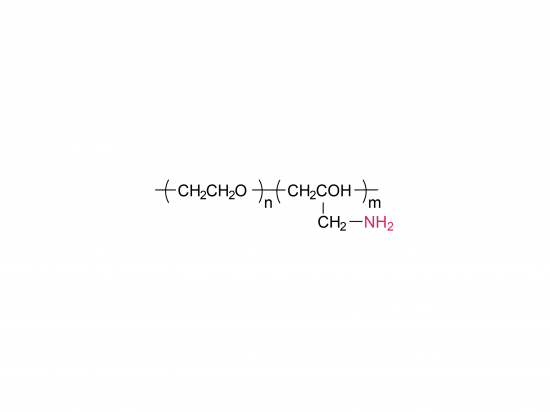
Example of an amine-functionalized PEG structure used in molecular modification and linker design.
For projects where a more defined molecular structure is important, monodisperse PEG linkers may be worth evaluating. A defined PEG chain can help researchers control molecular composition and characterize the intended structure more consistently. It does not, by itself, guarantee higher conjugation efficiency or better biological activity.
When Should You Consider Monodisperse PEG Linkers?
Monodisperse PEG linkers are useful when a project benefits from a more precisely defined PEG chain length and molecular composition. This can be particularly relevant to linker development, medicinal chemistry, and research where molecular structure needs to be characterized carefully.
Conventional polydisperse PEG materials contain a distribution of chain lengths, while monodisperse PEG products are designed around a defined molecular structure. The practical importance of this difference depends on the application, analytical requirements, and the level of structural control needed.
Before selecting a monodisperse linker, check the exact structure, molecular weight, terminal groups, available analytical information, and compatibility with the planned reaction. Researchers working on ADC or targeted protein degradation projects should also confirm that the chosen linker architecture fits the molecular design rather than selecting a reagent based on the application label alone.
For a broader comparison of PEG structures and available derivatives, researchers can also review SINOPEG's PEG product portfolio. The specific product should be selected according to the required functional group combination and molecular structure.
How Do Reaction Conditions Affect Linker Selection?
A linker that looks suitable on paper may not be appropriate if its reactive groups are incompatible with the reaction environment. Researchers should evaluate buffer composition, pH, solvent compatibility, temperature, reaction time, and the stability of both the linker and the target molecule.
For example, NHS esters can undergo hydrolysis in aqueous environments, which competes with the desired amine coupling. Thiol-maleimide reactions require suitable free thiols, and the stability of the resulting linkage may depend on its structure and surrounding conditions. Click chemistry can provide an alternative strategy when compatible azide and alkyne-derived groups are available.
For sequential conjugation, the first reaction must leave the second functional group available for the next step. Researchers should also consider whether purification is needed between reactions and whether the intermediate remains stable during handling and storage.
Before starting an experiment, confirm the reagent's recommended storage conditions and handling information using the supplier's product documentation. Conditions should be established for the specific molecular system rather than copied directly from an unrelated conjugation protocol.
What Should You Check Before Ordering a Heterobifunctional PEG Linker?
Before placing an order, prepare a concise specification covering the complete linker design. This helps distinguish products that may have similar names but different functional group combinations, spacer lengths, or protecting group arrangements.
- Functional groups at both ends: Specify the exact chemistry needed at each terminus, including whether a group must remain protected during an earlier reaction.
- PEG chain length or molecular weight: Identify the required spacer length and whether a defined molecular structure is important.
- Coupling sequence: Explain which end reacts first and how the second end will be used.
- Target molecule: Identify whether the linker will be used with a protein, peptide, antibody, small molecule, surface, or another component.
- Purity and analytical data: Review the available specifications and analytical documentation relevant to the project.
- Storage and handling: Confirm the recommended storage conditions and any requirements for protecting sensitive functional groups.
- Customization needs: If the exact combination is not listed, ask whether a suitable structure or chain length can be discussed with the supplier.
These details help research teams compare potential reagents and communicate their requirements to a supplier. If the exact combination is not listed in the online catalog, contact SINOPEG to ask about availability or possible custom synthesis.
Frequently Asked Questions
What is the main advantage of a heterobifunctional PEG linker?
A heterobifunctional PEG linker has two different functional groups, allowing each end to participate in a different coupling reaction. This makes it useful for connecting two molecular components when one reactive group cannot serve both coupling steps.
How do I select the right functional groups for targeted conjugation?
Start by identifying the accessible reactive groups on both target molecules. Match each linker end to a compatible reaction partner, then check reaction selectivity, buffer and solvent compatibility, and whether the second functional group remains available after the first coupling step.
Is a longer PEG linker always better for bioconjugation?
No. A longer PEG chain may provide greater molecular separation and flexibility, but it can also change the conjugate's geometry and properties. The appropriate length depends on molecular size, steric accessibility, solubility, and the requirements of the final conjugate.
Why choose monodisperse PEG linkers?
Monodisperse PEG linkers are designed to provide a more defined PEG chain length and molecular structure. They can be useful when molecular composition and structural characterization are important, although they do not automatically guarantee better reaction efficiency or biological performance.
Can one heterobifunctional PEG linker connect an amine-containing molecule and a thiol-containing molecule?
Yes, a suitable linker combining an amine-reactive group such as NHS ester and a thiol-reactive group such as maleimide may support this strategy. The exact reaction order and conditions must be selected based on the target molecules, functional group stability, and intended conjugate.
What information should I provide when requesting a PEG linker?
Provide the required functional groups at both ends, desired PEG chain length or molecular weight, target molecule types, intended coupling sequence, purity requirements, and any relevant storage or analytical specifications. These details help identify a suitable existing product or clarify whether customization is needed.
Scientific References and Further Reading
The following references provide background on PEG chemistry, bioconjugation, and linker design. They are intended as further reading rather than as evidence for a particular product's performance.
- Roberts, M. J., Bentley, M. D., & Harris, J. M. (2002). Chemistry for peptide and protein PEGylation. Advanced Drug Delivery Reviews, 54(4), 459–476. DOI: 10.1016/S0169-409X(02)00022-4.
- Hermanson, G. T. (2013). Bioconjugate Techniques (3rd ed.). Academic Press. A reference text covering common bioconjugation reagents, reaction mechanisms, and practical considerations.
Note: This article is intended for scientific and research information. The appropriate reagent and reaction conditions should be confirmed for the specific application using relevant experimental data and supplier documentation.